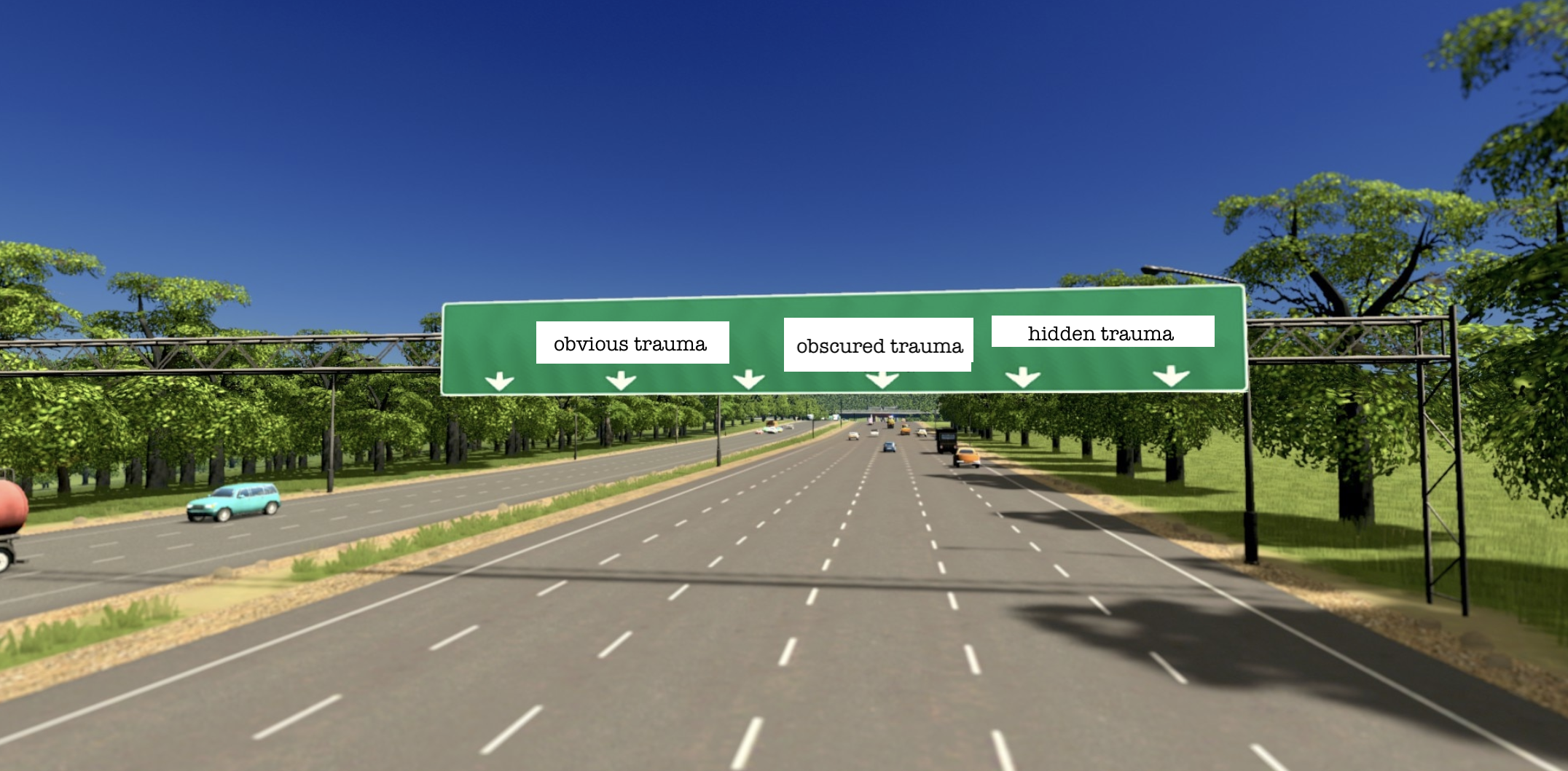
One of the hardest shifts to make in our healing journey is to allow intense words like trauma, abuse and neglect to have a wider meaning than we are comfortable with. It’s understandable that we prefer harm to mean one clear, obvious thing rather than a seemingly infinite sliding scale of possibilities. Much like when we hear that a mass public shooting was caused by one, mentally disturbed individual, a singular source of harm is a more soothing story. We find solace when the odds feel minimal that something tragic will find us next.
But what mental health professionals know is that narrow definitions of reality leave us stumbling around in dangerous territory without the ability to locate ourselves and validate the danger we feel. It’s like wandering in a minefield with a map of a 30 square yard area of land and being told there are only a few potential hazards to avoid, when the reality is that the dangerous zone is actually three-square acres, and the number of buried triggers is unknown. We would all traverse the ground very differently depending on which narrative we were believing.
The hard truth is that trauma, abuse and neglect are six, not single, lane highways. There is the fast lane on the far left where the reckless drivers and nice European cars speed at a neck breaking pace. Then there are the lanes in the middle where most people drive right above the speed limit, passing others more deliberately with a focus on getting to their destination on time. Then there is the second from right lane where the people who aren’t in a rush drive the speed limit, likely exiting in a few miles and not wanting to miss their turn. And then in the far-right lane are the people slowing down to get off the highway or in old vehicles or with elderly drivers not comfortable with the speed limit. Harm, trauma and abuse all have multiple speeds, not just one and knowing this means we can validate more of the pain that we feel and seek the help in healing we truly need.
Before I continue, I want to be clear that my hope in this article is NOT to encourage us to be more hypervigilance. Hypervigilance is defined as a state of excessive alertness, where our nervous systems remain constantly on guard, scanning our environments for perceived threats or dangers, even in safe situations. It’s an exhausting survival mechanism that feels like being “on edge.” While a normal protective response to danger, it becomes problematic when it persists, causing significant distress and interfering with life.
As a trauma survivor, my growth path the past several years has included being less future oriented out of fear. Instead of being consumed by the possibilities of what people will do or how things will play out, I’ve worked hard to stay more regulated in my present and confident that I will be cared for (by myself, by my resources, by those who love me) in whatever occurs that is both impossible to predict or prepare for.
Honestly, the better I have become at being less hypervigilant the more fragile and lost I have felt at times. I thought, at first, turning away from hypervigilance would mean a more peaceful, confident existence. There is some freedom that comes from less anxiety, but as I have let my ability to “feel into the future” develop the rust of underuse, I have felt more vulnerable, not less.
My hope in asserting that words like trauma are wider and deeper than we want to believe is to encourage us to listen to ourselves rather than dismiss or turn away from the truth we intuitively know in our bodies. Our path towards greater rest and freedom is not to deny the evil and harm in the world but to affirm our detecting it and let that lead and shape how we live.
Let’s start with one big word that we often underestimate in its prevalence: trauma.
The definition of trauma includes three essential aspects. A great way to remember them are the 3 Es: event, experience and effect. Trauma is not only what happens to us but also what our experience is of that event and then the effect our experience has on us. There are, of course, some events that are widely considered traumatic because they would be dysregulating for almost every human on the planet. A tsunami would be an excellent example.
A person sunbathing on a beach who detects the eerily receding of waves and then sprints inland to safety will experience the event differently than a person in a helicopter hundreds of feet above the ocean’s surface. And the effect from the experience of those different vantage points will be different for each of them. A person who makes it safely to a shelter and survives, but then later will walk through a landscape floating with dead bodies will see a different effect than someone witnessing from above the first big seismic wave hitting the shore and killing hundreds of unaware people before flying off to land miles away from the carnage. These two tsunami stories would be an example of what trauma can and does look like in the fast lane.
Middle lane experiences of trauma that I have seen from a therapist chair include divorce in families, children of parents who went through long periods of depression or chronic illness, partners taking care of a spouse with dementia for decades, and food insecurity for families living below the poverty line. These are not “easier” things to deal with than a tsunami but they are more normally occurring events so we don’t quickly label them as traumatic because they are less physically intense or more prolonged.
And finally, the slow lane may include events like an introverted preteen moving to a foreign country for a parent’s job change and entering adolescence without a vital sense of belonging. Or a company promoting a young executive over an employee in their 50s because they can pay them less for a management role because they have less seniority. Or a highly driven young athlete losing a competition because of an erroneous call by an official. All these things we would say just happen every day and we know a hundred other examples in our lifetime of these types of stories so we easily dismiss the experience it is for a particular individual and the lasting effect it can leave on their lives.
In the coming months, we will look more specifically at the different forms of abuse and neglect we can encounter in our stories. We’ll look at what the defining elements are for these experiences and try to unmask the forms of abuse and neglect in the middle and slow lanes that can go unnamed, unaddressed and unhealed in our lives for years.
Reflective Exercise:
On a piece of paper (ideally in a journal or notebook) draw a picture of a six-lane highway. Begin a list of events you experienced in your story that carried different levels of intensity and write each in one of the six lanes. I encourage you to not spend too much time thinking about where to put it, but instead let a sense of how big it felt to you at the time it happened lead you to place it in a lane. Keep in mind the 3 Es of trauma—not only the event but also the experience it was for you and the effect it had on you. Can you give each event in a lane one word to describe the experience (overwhelming, confusing, shameful, heavy, disorienting, sad, etc.) and a phrase to describe the effect it had on you (insecure, afraid of strangers, out of place with my peers, started restricting food, expecting rejection from then on, etc.)?