Shame as Grounding

Gravity.jpg

I’ve described shame in many ways over the past few years--dark, insidious, infiltrating, corrupt, deceptive, binding, etc. But in the past few months, my work has cornered me into adding another adjective to the list--grounding.

Juxtaposing these two words I’ve held as antithetical for so long has created quite the dilemma.

The seed was first planted during one of my own therapy appointments two years ago. As I processed a scene from when I was seven years old, I was astounded to discover that in the aftermath of hurt my internally, berating dialogue had actually anchored me. Holed up in a bathroom where I felt safe to cry, the “talking to” I gave myself before exiting seemed to strengthen me in the difficult task of returning to my family.

For days after the session, I was perplexed:

“That was strange. It felt like I honored shame. Surely that’s not right--I must be misunderstanding what happened.”

Fast forward to this past December as I read in a story group another scene from first grade. Everyone helped me hear my harshness towards myself as a coping mechanism. My writing ended with these words:

Earlier. That’s what I should have done. I should have thought of my idea earlier.  I should have guessed he’d come home. Instead of mindlessly wasting the day away, why didn’t I make a plan for tonight? Even if I was wrong, I could have been at my grandmother’s. I should have thought of that. I shouldn’t have waited so long. I should have realized the afternoon was almost over and it’d be too late. Earlier. I need to think about things earlier.

Until a few weeks ago, I continued to think this was something only I did. Another story group member, sharing a very different story, also ended with a similar internal dialogue. Outside of my own mind and voice, I could finally hear the litany of “should”s as a way of grappling with unpredictable and unpreventable pain.

As I’ve held the words shame and grounding together, I’ve begun to think of it like this…

In the presence of harm, the experience of powerlessness feels untethered. Like in every space movie that I’ve seen (Ad Astra, Gravity, Interstellar, The Martian) an unforeseen explosion catapults us away from the only vessel with engine thrusters powerful enough to break the orbit of an uninhabitable planet. We watch in horror as the chord of our life suit detaches from our spacecraft and we drift into oblivion.

It is in this type of nightmare that shame grounds us. It’s not a kind ground on which to stand—it’s more like wet cement that entraps you as it congeals—but it does provide temporary relief from the disorientation of spinning away from those to whom we are meant to belong.

I believe any measure of relief in an experience of trauma is a form of mercy, and whether it’s in my story or in someone else’s, if shame provides a sliver of relief then I need to honor the way it anchors survival before asking it to step aside.

What internal speech do you most often give yourself? When was that recording first dubbed? What story of historic inner harshness do you need to tell in order to reframe it as how you grounded yourself to survive powerlessness? 
Flaws as Mediums

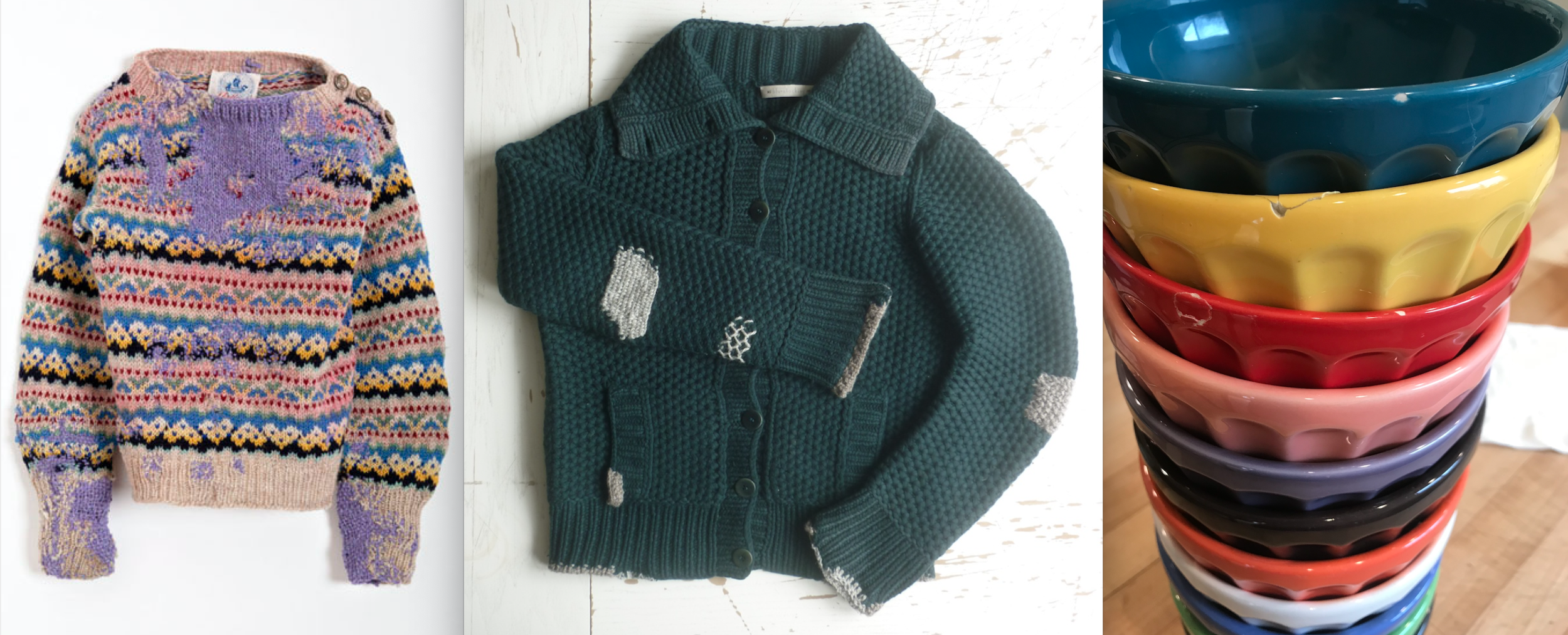
Artistry by Celia Pym (left), Tom van Deijnen (middle) and my husband (right).

Artistry by Celia Pym (left), Tom van Deijnen (middle) and my husband (right).

Visible Mending. This past week, as I bathed in Jan Richardson’s Epiphany writings, this captivating phrase rubbed me raw then seeped into my bones.

Visible mending doesn’t seek to dismiss the presence of damage or disguise its restoration. Instead, it allows a repair to show itself, taking a defiant delight in salvaging what some might consider ruined.

Richardson’s inspiration comes from the works of English artists such as Celia Pym & Tom van Deijnen (shown above). As I perused their portfolios, a question from my own deep brokenness rose up:

“Why would you do that?!?!”

Damaged objects get under my skin. I am among those who consider them ruined. If finances allow, I replace broken household items with neck-breaking speed. My husband’s refusal to acknowledge a freezer on its last leg until steaks spoil rather than when it stops making ice, balances me out. We don’t do visible mendings—we do poorly disguised chips in my favorite Anthropologie latte bowls. Also shown above.

Which begs the question…

“Why do I do that?!?!”

Growing up, my mom’s telling of my birth story went something like this:

“My due date was in early December so I had this cute ‘Baby’s First Christmas’ outfit for you. But you took so long to come that you didn’t get to wear it that year. Of course you were too big for it by the next Christmas, so I never got to put it on you.”

A wise man (a therapist, of course) reframed it this way:

“So you ruined Christmas while still in the womb?

That does sound crazy.

I refrained from sharing that actually I ruined New Years as well. Pregnancy complications meant bed rest for my mom the week between the two holidays. I was delivered by emergency c-section on Wednesday, January 2nd—an official child of woe.

It’s relieving to know I come by my crazy honest.

I’m grateful Jan Richardson answers my very important why:

Why purposely mend a garment in a way that draws attention to its flaws?

The point of such repair is not to erase every sign of damage; the point, in part, is to show that the damage does not have the final word. What finally emerges from the mending will be both scarred and beautiful. Most of all, it will be whole.

Turns out when something precious is irreplaceable (for whatever reasons), the pain of parting with it changes your perspective on damage. Flaws become the medium for repair when wholeness becomes enough.

How did your family respond to damaged and broken things? Whether it was a meal, a mood, a vacation or a report card, what do you remember “ruining” growing up? Were “scarred” things considered beautiful in your family? What story of damage do you need to tell in order to make room for the wholeness visible mendings create?

Tell your story

Between Touches Zoom Call: Monday, January 27th 6-7:30pm MST

(1 spot left)

Denver Story Group: Monday, February 10th 6-9pm @SC

(2 spots left)

Wounds as Doorways

Rock of Cashel: Tipperary, Ireland

Rock of Cashel: Tipperary, Ireland

I think of wounds as barriers—obstacles closing off a path I was originally intended to follow. Thus, my new year’s resolutions have often sought to circumvent the pain of my story the way you would finagle faulty electrical circuits in an old house to accomodate a modern, high voltage appliance. I’d write my resolutions in a new journal couched in words like healing, transformation and growth. All good words, but looking back I see my desire was to circumvent my wounds rather than allow them to usher me through a threshold I am meant to cross.

So today, on this day after Epiphany and, more gloriously, my kids’ first day back at school, these lines from a poem by Jan Richardson ignite in me a genuine spark of hope as I face this new decade.

“Singing to the Night”

Who would have thought

the sky could be so pierced,

or that it could pour forth such

light through the breach

whose shape matched

so precisely

the hole in the heart

that had ached

for long ages,

weary from all its emptying?

And what had once been

a wound

opened now

like a door

or a dream,

radiant in its welcome,

singing to the night

that would prove itself

at last

not endless.” ***

How are you weary from feeling emptied by the past or aching from a historic breach of your heart? How might this wound, if trusted, understood and allowed to guide you, lead you closer to the end of a long night? What if, this year, you didn’t seek to be different but only to be whole?

***To read the rest of the poem, download Jan Richardson’s free Epiphany retreat here. It’s seriously the best free thing on the planet! https://sanctuaryofwomen.com/WomensChristmasRetreat2020.pdf

A Christmas Benediction

Screen Shot 2019-12-23 at 7.11.42 AM.png

May you know comfort as well as joy

May the path to misery be closed off to you

May nothing cause you dismay

May glad and golden hours come

May the weariness of your world not prevent your rejoicing

May you, along with all peoples, be raised up

May all your oppression cease

May you not be a stranger to your weakness

May you be released from your fears and sin

May you rise with healing in your wings

May death’s dark shadows be put to flight

And may your soul feel its worth.