Not Exempt, Not Enough

Screen Shot 2020-06-15 at 1.42.05 PM.png

I am not yet confident enough to explain what it means to be anti-racist, but I’m starting to understand what it is not.

I lived outside the US for 17 years.

That’s not enough.

I didn’t vote for Trump.

That’s not enough.

I married a person of color.

That’s not enough.

I’m raising biracial children.

That’s not enough.

I even read Austin Channing Brown’s book I’m Still Here before it was on the New York Time’s Best Seller list.

Even that’s not enough.

I have a feeling that being anti-racist isn’t what I do outwardly but more about what I do when white supremacy manifests itself through me.

A few months ago I was in a room with beautiful people (talking about diversity and equity no less) and a colleague handed me a piece of paper that he later took back because of a printing error.

“Indian giver,” I called him jokingly.

My Native American colleague sitting besides me instantly gasped and confusion, terror and panic flooded me. It took only a few minutes in a short conversation with her to understand the magnitude of what I had said, but it took days for the shame to dissipate.

I left that encounter horrified that it had never occurred to me that the term was derogatory. I was tempted to believe that had been an unfortunate exception in how I communicate around people of color, but I know it wasn’t. I grew up in a small town outside Austin and I’ve said that phrase hundreds of times. It was just the first time I’d had gracious help interpreting it.

I am not exempt from being racist.

And I’d like to think that was a one time event, a singular blemish on my heart to love all people but this weekend reminded me it wasn’t.

Saturday, I was with a community of church volunteers helping a black client move into her new apartment. At one point she told us we could leave the mattresses in her living room and her kids would help her move them later. Before I could blink, the sentence, “You have plenty of slave labor if you need it,” began rolling off my lips. I caught myself mid sentence. Again, horror, terror and panic came. I don’t know if anyone heard me in the crowded, chattering room but I heard myself.

And I’m still wrestling with the shame.

I’m a social worker for God’s sake. I married a person of color. I raise biracial children. I’m hardly even American. I know better.

None of that is enough. None of that makes me exempt.

White supremacy is in me. It’s in my language, my frames of reference, my lens. It’s the reason I get a large tax return as a homeowner. It’s everywhere. It’s in my DNA.

How do I purge my very DNA?

I’m still answering this question but I know part of the process will include asking the pastor of the church and the mom we were all helping if they heard the first half of my sentence. It’ll involve repair.

But I’m not ready to do that yet. I’m waiting a few days for my shame to dissipate and my courage to build. It’ll take a few days before I approach them so that I’m ready to care for them instead of inviting them to care for me.

I am not exempt from being racist. I wonder if any of us are.
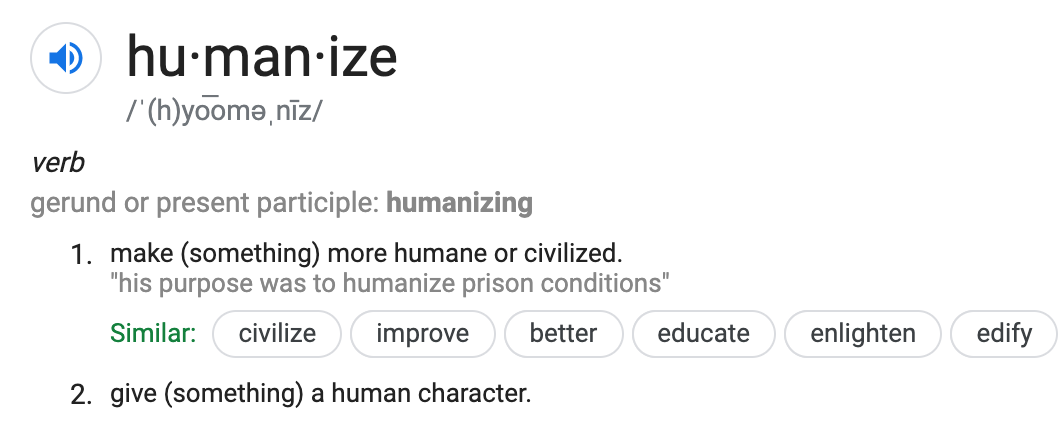
The Work of Humanizing

Screen Shot 2020-06-12 at 9.23.16 AM.png

For months before the deaths of Ahmaud Arbery, Breonna Taylor and George Floyd, I’d been thinking a lot about what it means to see people as human--not as sub-human or super-human but simply as human.

In the past two weeks, I’ve heard the wise, prophetic and caring black community say this to me as a white person:

  • Do your work.

  • Do it for the long haul.

  • Do it with other white people.

(They have said much more than this and much more eloquently—this is only a rudimentary summary.)

As a narrative therapist, I have always believed I have to do the work of knowing my own story before I can care about the stories of others. I will never empathize with another’s experience of oppression until I have named harm in my own life.

When it comes to telling the truth about our lives, I watch myself and others primarily lean one of two directions

1. An initial dive into our past confronts of us with traumatic things our parents did or failed to protect us from. This often leads to our first version requiring us to name the horror and terror we experienced, often painting our parents as caricatures of monsters.

OR

2. An initial dive into our past confronts us with emotional neglect and black holes in our family that absorbed the light and air necessary to be our true self. This often leads to our first telling feeling fuzzy, tentative and unjust and invites us to use overly forgiving phrases like, “they did the best they could with what they had.” We paint picture of our parents as imperfect superheros loftily floating in the sky above us rather than people who feel close and concrete.  

In Alain de Botton’s talk “Why You Will Marry the Wrong Person” he describes how our hope of loving someone begins with our ability to hold together opposing truths about those who raised us (time stamp: 9:33-11:33).

Anyone we love is going to be a perplexing mixture of the good and the bad. Ambivalence is an immense psychological achievement—the ability to both hate and love someone. We start off with idealization and we end up often with denigration. True psychological maturity is the capacity to realize that anyone you love is going to be a mixture of the good and the bad. Love is the recognition of ambivalence.

What story do you need to tell of both the tragedy and the beauty of those who raised you? How will you engage the work to see those in your story, as well as yourself, as more human in order to embrace the humanity of others?

Want to experience what it means to do your own story work?

download.jpeg

Join a FREE 90-minute community call discussing actor Shia LaBeouf’s journey of telling his story and humanizing his father through the making of his film Honey Boy.

Date: Monday, June 29th from 6:00-7:30 PM MST

FIND OUT MORE

Impotent Evidence

video_evidence769x468.jpg

I’ve seen in my own healing journey, and as a guide to many others, how wrestling with a memory creates a longing for a transcript or a video of the moment.

Did my mother’s voice really sound that harsh or was I an overly sensitive child? Was I forgotten at the store for hours or did it just feel that long? Was my older sister actually jealous when my grades were praised or did I imagine that?

Somehow, we’ve come to believe that an accurate telling of events only comes from an outside perspective rather than learning to trust the inner experience of our mind, heart and body.

The black community in America has understood this truth since 1991.

Speaking last week on behalf of the doubts of the black community that a recording of the death of Ahmaud Arbery will result in a conviction of his murderers, Jimmy McGee, director of The Impact Movement, shared his memory (see time stamp 40:02) of when the “first video” was shared with the world:

I can tell you the first time there was a video camera that recorded Rodney King getting beat down by a whole bunch of cops. I can tell you across the nation, even though I wasn’t in LA, we all said with a big sigh, ‘Now everybody can see how we’re abused.’

The understanding was that now that it’s on video, these cops are going to be found guilty and now we can live as black people. And the riots came when they were all exonerated by a jury,

Now I know that they can see something recorded and still not be provoked to see value in my black body.

Validation of an experience doesn’t come because you have a video of the event.

Yesterday, I watched Sterling K. Brown’s video after his 2.23 mile run for Ahmaud. It is another type of “evidence”—a heart-felt description of his racial experience as a black man in American in the metaphor of being unable to breath while wearing a quarantine mask while exercising.

White America will not believe the stories of our black brothers’ and sisters’ racial experiences until we validate the inner experience of our own life stories. We need to listen to their wisdom from 19 years of disappointment—a video is impotent evidence in believing the truth of our experience.

What story have you wanted “video evidence” for in order to feel validated to speak or write about? What story do you need to tell in order to be present with the emotions of people in your life?

Denigration as Protection

Screen Shot 2020-05-04 at 6.30.26 AM.png

A year ago, this video by Dr. Joy DeGruy left me speechless. Could public denigration of a young black boy, by his very own mother, have its roots in an act of protection? Now, rewatching this in the midst of COVID-19 disproportionately ravaging communities of color is even more heartbreaking.

In January, my son’s history teacher lent me Between the World and Me by Ta-Nehisi Coates. He writes:

When I was six, Ma and Dad took me to a local park. I slipped from their gaze and found a playground. Your grandparents spent anxious minutes looking for me. When they found me, Dad did what every parent I knew would have done—he reached for his belt. I remember watching him in a kind of daze, awed at the distance between punishment and offense. Later, I would hear it in Dad’s voice—”Either I can beat him, or the police.” Maybe that saved me. Maybe it didn’t. All I know is, the violence rose from the fear like smoke from a fire, and I cannot say whether that violence, even administered in fear and love, sounded the alarm or choked us at the exit.

During quarantine Matthew Desmond’s Evicted: Poverty and Profit in the American City has taught me that eviction is for black women what mass incarceration is for black men. Telling the story of one black mother and her two sons navigating cycles of homelessness and eviction, Desmond writes:

Arleen sacrificed for her boys, fed them as best she could, clothed them with what she had. But when they wanted more than she could give, she had ways of telling them they didn’t deserve it. When Jori wanted something most teenagers want, new shoes or a hair product, she would tell him he was selfish, or just bad. Sometimes when Jafaris was hungry, Arleen would tell him to stay out of the barren cupboards because he was getting too fat. You could only say “I’m sorry, I can’t” so many times before you began to feel worthless, edging closer to a breaking point. So you protected yourself by finding ways to say “No, I won’t.” I cannot help you. So, I will find you unworthy of help.

Connecting these dots, on behalf of all my friends of color, has been sobering. Though these stories are specific to the black experience in America’s white supremacist culture, I can imagine there is a unique translation for my Asian-American, Latin-X and Native American friends as well. These writers have also left me wondering if there is truth here for my own story? How might my mother’s history of trauma, coupled with the powerlessness she experienced as she raised me, translated into denigrating messages meant to protect either mine or her’s tenuous survival?

How do you remember feeling devalued as a child? Who communicated you were unworthy in some way because they were unable to provide something, tangible or intangible, that you needed or wanted? What story of fear driven punishment do you need to tell in order to excavate the flawed care that left you wounded? How was this story, in Ta-Nehisi Coates’s words, both an alarm and a choking of your sense of worth?

I’m greatly indebted to the Young Life staff who have expanded my story lens through the privilege of entering into their narratives. This stretching process began with feeling mystified as I explored a generational racial history unlike my own, but the journey has profoundly nourished my understanding of story.